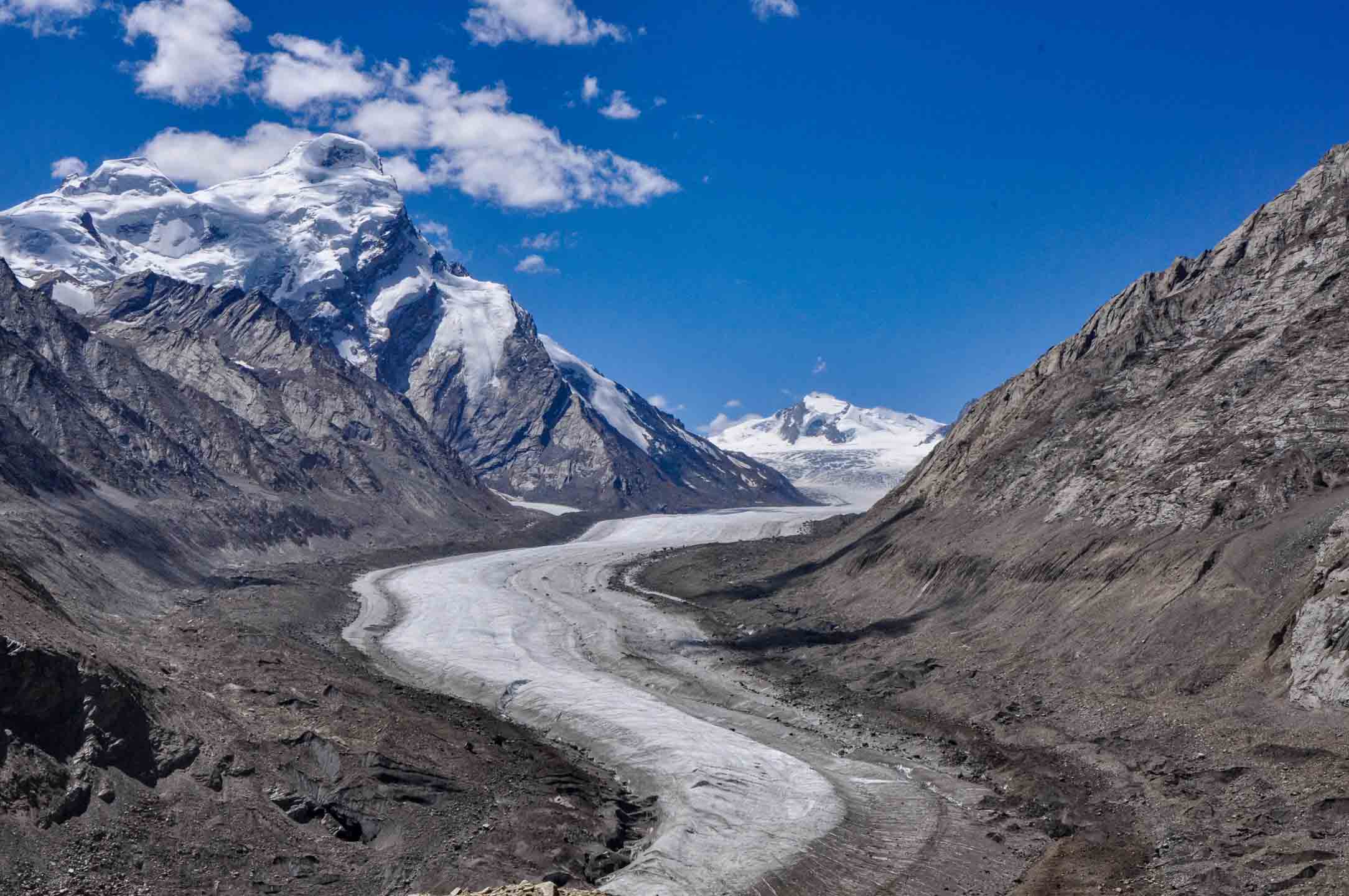
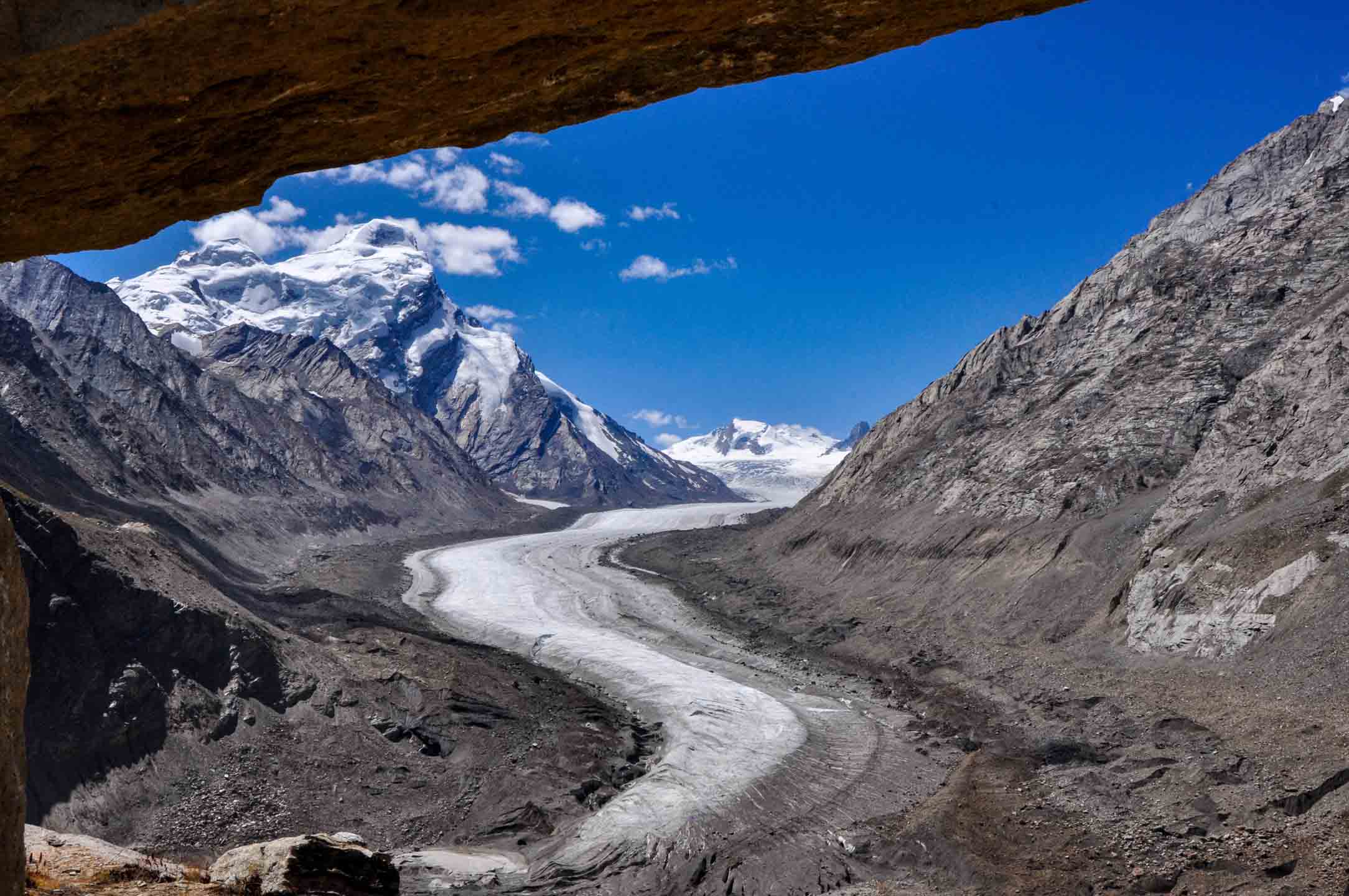
Drang Drung Glacier is one of Ladakh’s most awe-inspiring natural wonders. Stretching for nearly 23 kilometres, it is the second-largest glacier in Ladakh after the Siachen Glacier and among the most accessible large glaciers in the Indian Himalayas. Originating from the high peaks of the Zanskar Range, the glacier slowly flows down the mountainside in a broad ribbon of ice, carving its way through the rugged landscape over thousands of years. Unlike many glaciers that require days of trekking
to reach, Drang Drung can be admired from the roadside near Pensi La Pass, making it one of the few places where visitors can witness the sheer scale of a Himalayan glacier with relatively little effort.
The best views of the glacier are from Pensi La Pass, situated at an altitude of approximately 4,400 metres. This high mountain pass marks the transition between Suru Valley and Zanskar Valley and offers a panoramic viewpoint overlooking the glacier. From here, the glacier appears like a frozen river winding through a maze of dark brown and grey mountains. Its surface is far from smooth, with countless ridges, cracks, icefalls, and deep crevasses formed as the massive body of ice slowly moves downhill under its own weight. Depending on the season and the angle of the sunlight, visitors may notice brilliant white snowfields, shades of blue ice, and rocky debris carried by the glacier over centuries.
Drang Drung is far more than a scenic attraction. It serves as one of the primary sources of the Stod River, which joins the Tsarap River near Padum to form the Zanskar River. The glacier’s annual meltwater sustains villages, irrigates fields, and supports agriculture in one of the coldest and driest inhabited regions of the world. In a landscape where rainfall is extremely limited, glaciers such as Drang Drung act as natural reservoirs, storing winter snowfall and gradually releasing water throughout the warmer months. This seasonal flow is essential for both human settlements and the fragile ecosystems that have adapted to life at high altitudes.
The glacier has also shaped the geography of Zanskar over countless millennia. As it advanced and retreated through different climatic periods, it carved broad valleys, deposited rocky moraines, and influenced the courses of rivers throughout the region. Geologists consider glaciers like Drang Drung to be living records of the Earth’s climatic history, preserving evidence of environmental changes that occurred thousands of years ago. Even
today, the glacier continues its slow movement, although at a pace that is almost impossible to detect with the naked eye.
Travelling to Drang Drung is an experience in itself. The road climbs steadily towards Pensi La through barren mountains, alpine meadows, and seasonal streams before suddenly revealing the vast sheet of ice stretching across the horizon. Prayer flags flutter in the mountain wind while travellers pause at the viewpoint to absorb one of Ladakh’s most unforgettable panoramas. During summer, patches of green valley contrast dramatically with the glacier’s white and blue ice, while in autumn the surrounding mountains take on warm golden and reddish hues. On clear days, the silence of the landscape, broken only by the sound of the wind, gives the place an almost timeless quality.
Like many Himalayan glaciers, Drang Drung is also facing the effects of climate change. Scientific studies have shown that glaciers across the Himalayas are gradually retreating as average temperatures rise, affecting water availability and increasing the risk of glacial hazards in the future. Although Drang Drung remains an imposing presence, it stands as a reminder of the delicate balance that sustains life in the high Himalayas. Visiting the glacier is not only an opportunity to witness one of Ladakh’s greatest natural landmarks but also to appreciate the importance of preserving these frozen landscapes for future generations.
The journey from Suru Valley to Zanskar is remarkable because of the dramatic transformation it offers. It begins in one of Ladakh’s greenest valleys, where farming communities have flourished for centuries, and gradually unfolds into a world of glaciers, alpine plateaus, and isolated monasteries.
For us, this was one of the most memorable drives, not simply because of its spectacular scenery, but because it revealed how remarkably diverse the region truly is. Few journeys capture Ladakh’s changing landscapes so completely, taking travellers from fertile valleys to the very edge of the high Himalayan wilderness.