the path of the phoenix a testament of resilience a journey

The Path of the Phoenix: A Testament of Resilience
The Testament of Resilience
This is the story of suffering and survival that Poland tells—from Auschwitz to Kraków to
Warsaw. Auschwitz is a sombre memory against oblivion. Kraków is a beautiful city that half
preserves the past and half believe in the present. Warsaw is the paragon of resilience,
rebuilt stone by stone; a city of a phoenix with memory and progress in thriving coexistence.
They remind us not only of what was taken, but what remained; the bravery of those who
said no, the strength of cities rebuilt and the indomitable human spirit which refuses to fall.
To tread this path is to walk through ashes and light, despair and hope. That remembrance is
not a passive act, but one of active duty, one towards taking steps to ensure history does not
repeat.
The Polish route of the phoenix is warning and an evidence — that life can rise from the
ruins, that light can survive the darkness.
Auschwitz- Where death lingered
Auschwitz, preserved today as a memorial and museum, southwest of Kraków in the small
town of Oświęcim. It was not one camp but a web of sites: Auschwitz I, Auschwitz IIBirkenau and Auschwitz III-Monowitz, with dozens of subcamps surrounding them.
Auschwitz I was founded in 1940 in barracks built for the Polish army. The infamous iron gate
there still bears the words Arbeit Macht Frei (“Work Sets You Free”), a cruel swindle, Inside,
inmates suffered hunger, forced labor, medical experiments and executions. Men, women,
and children were housed in brick barracks under inhuman circumstances.
Opened in 1941, Auschwitz II-Birkenau would go on to be the primary site of mass
extermination. It covered an immense area, including wooden barracks, guard towers, and
train tracks that went right into the camp. This is where over a million Jews, as well as Roma,
Soviet POWs and others were gassed and cremated together. The vastness of Birkenau—the
barrack-lined expanses, the remnants of crematoria—forces patrons to reckon with genocide
as a factory process.
Labor camps were also built (Auschwitz III-Monowitz) linked to the IG Farben factory in
which inmates worked under grueling conditions with many succumbing to exhaustion and
starvation.
Instead, today not only the physical evidence but also the memory of those who lost their
lives is preserved at the Auschwitz-Birkenau Memorial and Museum. The exhibits are as
powerful a statement as you can find in the world:
The Shoes Room: stacks of shoes—men’s boots, women’s heels, children’s sandals—piled
on top of one another. These speak of the life they had, a journey halted.
Suitcases: Piled high, labelled with names, dates of birth, and addresses, abandoned by
victims told they were being “settled”.
Exhibit of Hair: Human hair (taken from prisoners) behind glass — remnants of people
having had their lives taken away from them.
Images: IDs of each inmate, hollow eyes staring, people lost emotionally as much as
physically. These images of horrible agony turned silent witnesses to the suffering of each
individual.
Personal effects: eyeglasses, prayer shawls, cooking pots, toys – the archaeology of the
quotidian, the archaeology of absence.
And then the gas chambers – at Auschwitz, experimentation with Zyklon B gas began, and it
was later used in all the other camps.
It is more than a history lesson that you learn between the walls of Auschwitz; it is a
confrontation with cruelty of man—and with the duty to remember. And there is a solemn
silence that blankets over the ruins of scene in Birkenau. Watchtowers stand unoccupied,
barbed wire gains rust, but the misery echoes.
Kraków – The City of Remembrance and Charm
While loss dwells in Auschwitz, Kraków is a testament to resilience. The city is one of
Poland’s oldest, and much of the medieval core of the old towns was left unharmed during
the war. For many centuries, it was home to a prosperous Jewish community, mainly in
Kazimierz, the Jewish quarter, which too offers evidence of a near-vanished culture in the
shape of synagogues, tight alleys.
Rynek Główny (Main Market Square) in Kraków is the largest medieval square in Europe
lined with pastel-colored townhouses, cafés, and attractions. At its heart stands the Cloth
Hall (Sukiennice), which was the heart of Renaissance commerce. Next to it, the twin spires
of St Marys Basilica rise, where every hour a trumpet call—the Hejnał—is broadcasted, the
melody cut abruptly at the end to commemorate the trumpeter shot by a Tatar arrow
centuries ago.
Wawel Castle, home of Polish kings, towers above the Vistula, the river that defined the city.
A mausoleum for Poland’s monarchs, poets and heroes, it is a symbol of national identity
and pride, too.
However, the spirit of Kraków does not reside solely in its monuments but in its streets,
adorned with flaneurs on cobblesstreets, students and artists in cafés, violinists on street
corners in the dusk.
The nearby Jewish quarter, Kazimierz, has been revitalized in recent years with Jewish
festivals, klezmer music and kosher restaurants celebrating a past that has survived tragedy.
The Zgody Square or the Jewish Heroes Square has installations of 70 empty chairs, to serve
as constant reminders of the belongings they were forced to leave as they vacated their
homes, representing absence and loss.
Oscar Schindler’s factory, now turned into a museum, narrates the story of the Jews of
Kraków.
And so, Kraków, in this sense, is a phoenix — born out of the ashes of the absence of its
community, and held within its memory.
Warsaw – The Phoenix City
Which is how, if Kraków came through the war, Warsaw had been barely out. After the failed
Warsaw Uprising of 1944 the Nazis razed the city to the ground by destroying more than
85% of all buildings. And out of those ashes Warsaw rebuilt herself — Phoenix City, they
called it.
This picture of Warsaw after the war stands as a powerful symbol of destruction—but also of
resilience. Almost completely rebuilt from ruins, the city’s remarkable resurrection reflects
the determination and spirit of its people.
Over 400,000 Jews were trapped in what became the largest Jewish ghetto in Nazi-occupied
Europe — the so-called Warsaw Ghetto. Its numbers were wiped out by starvation, illness
and deportations to Treblinka. In 1943 desperate fighters in the Warsaw Ghetto defended
themselves against overwhelming Nazi forces—the first urban insurrection against the
Nazis—holding out for three weeks before being destroyed.
Today, memorials cover these sites in Warsaw: the Heroes Monument, the Umschlagplatz
(the place from which Jews were shoved onto cattle wagons), and pieces of ghetto wall
tucked between modern buildings. There is now the POLIN Museum of the History of Polish
Jews on the site of the former ghetto, tracing a thousand years of Jewish life in Poland, not
just its annihilation.
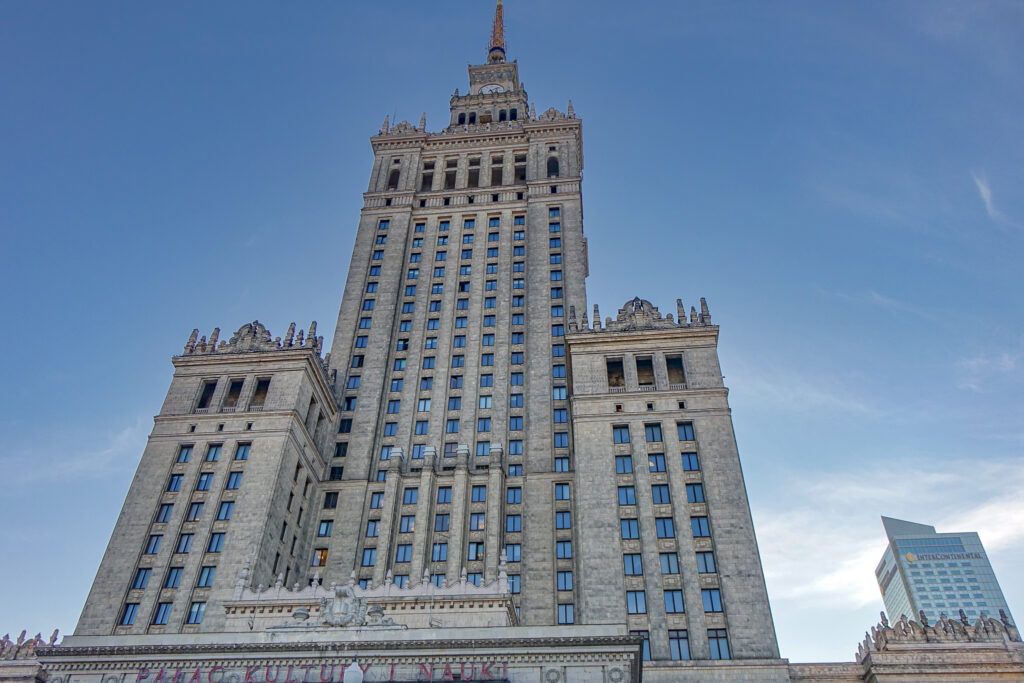
This building today houses the Ministry of Culture. However, many locals in Poland dislike it,
as it was built using money looted by the Russians from Poland.
Its Old Town, painstakingly rebuilt according to Canaletto paintings after the war, is a
UNESCO World Heritage site: memory as a mode of survival. The Royal Castle, destroyed to
the ground, reconstructed, filled with Polish art and history.
But Warsaw also has an air of modernity to it, as well. It speaks in wide boulevards, crowded
cafes, Zlote Tarasy, The Palace of Culture and Science (Pałac Kultury i Nauki), Chopin concerts
in Łazienki Park, contemporary art galleries, and many skyscrapers grow up with
reconstructed palaces—all the things to say that Warsaw is not a destruction, but a renewal.